
Editorial graphic illustrating the article’s subject.
What changes when you do not learn AI?
A familiar task can begin to work differently before a job title changes. A colleague may use AI to organise meeting notes, draft a customer response or compare information across documents. Someone who has never tried these tools can find it harder to judge the output, contribute to a new workflow or explain where automation would create a problem.
That does not mean everyone who avoids AI will lose their job. The International Labour Organization’s 2025 research describes occupational exposure as potential task change, with human input continuing to matter. Exposure is not a prediction about an individual’s employment. The useful response is to build understanding and evidence, rather than treat every new tool as a threat.
The real gap is judgement as well as tool use
An AI skills gap is more than not knowing how to write a prompt. It can include difficulty choosing an appropriate task, explaining the inputs, checking a result and deciding when a person should take over. A polished response can still contain incorrect details. Copying it directly into a client email or a business record can create more work than it saves.
Start with the expertise you already have. A developer can review generated code against a requirement. A marketer can check whether a draft matches the offer and audience. An operations team can identify missing fields in an extracted document. Domain knowledge makes evaluation possible; AI familiarity helps you apply it in a changing workflow.
Learn the difference between AI and ordinary automation
A fixed rule is often enough to send a reminder, validate a required field or move a record between systems. AI is more useful when a task involves variable language, documents or classification that cannot be expressed with a few dependable rules. Mixing the two can be useful, but adding a model to every step increases complexity and operating cost.
Consider an enquiry workflow. Conventional automation can capture the form and notify the right team. AI might suggest a category or draft a summary. A person should review uncertain requests and approve the response where needed. This is an example to evaluate, not a promise that the same setup suits every company.
A practical 30-day AI learning plan
Week one: choose one low-risk task you understand well. Write down the current steps and collect a few anonymised examples. Learn the approved tool’s data controls and practise explaining the desired output. Keep confidential client information out of unapproved services.
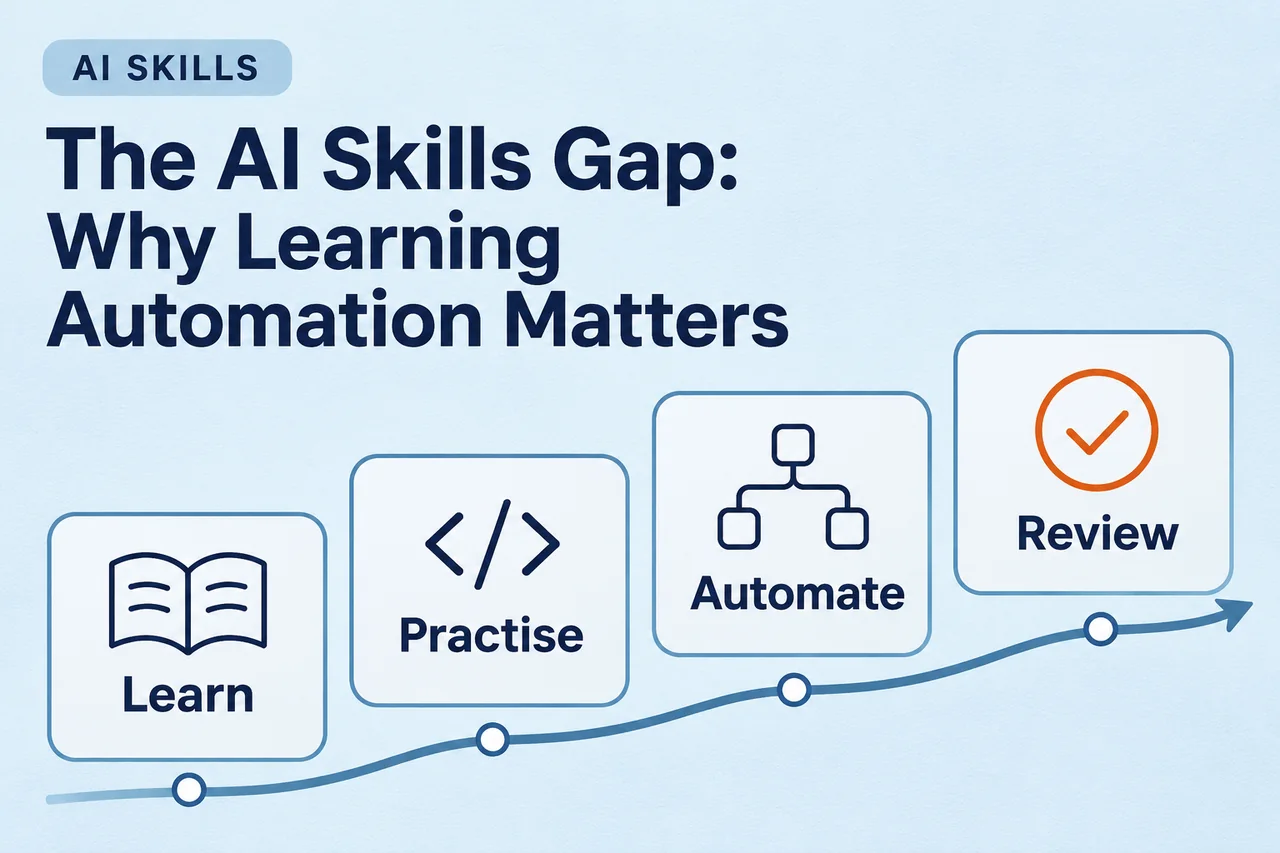
Week two: compare AI-assisted outputs with your normal process. Record inaccuracies and the time spent checking them. Week three: connect one simple automation only if the inputs and output checks are reliable. Week four: review the whole workflow with a colleague. Keep it only if it improves the task after review time, subscriptions and maintenance are included. This is a learning schedule, not a guarantee of proficiency in a month.
What business owners and team leaders should do
Give people a defined learning task, an approved environment and time to practise. A list of tools without a real business problem rarely produces a dependable process. Ask teams where information is repeatedly copied, which questions recur and where a missing approval could cause harm. Those conversations can reveal both useful opportunities and work that should remain manual.
Measure a baseline before deciding that automation is successful. Compare time per completed task, corrections, failed cases and customer experience. Keep a named owner and a clear fallback. The NIST generative AI risk-management profile provides a useful reference for thinking about evaluation and oversight, although each business must adapt its approach to its own use case.
Start small and build evidence
For businesses in Lucknow and across India, the starting point does not need to be a complete AI transformation. It may be a better enquiry process, a searchable internal knowledge base or a reviewed document workflow. The goal is to make one repeated job clearer and more dependable.
Webcotec helps scope AI assistants, workflow automation and the software integrations behind them. Bring your existing process, sample inputs you are allowed to share and a description of the result you need. We can assess whether conventional automation, AI or a simpler software improvement is the sensible first step.
Common questions
Do I need coding skills to start learning AI automation?
You can begin by mapping a task, testing an approved tool and checking its output without writing code. Integrations, access controls and production reliability may need technical support.
Will learning AI guarantee job security?
No. AI skills can help you adapt, but employment depends on many factors. Develop domain knowledge, communication and problem-solving alongside practical tool experience.
What is a good first automation project?
Choose a frequent, low-risk task with clear inputs and an output a person can verify. Avoid making a first experiment responsible for payments, sensitive decisions or unreviewed customer commitments.