
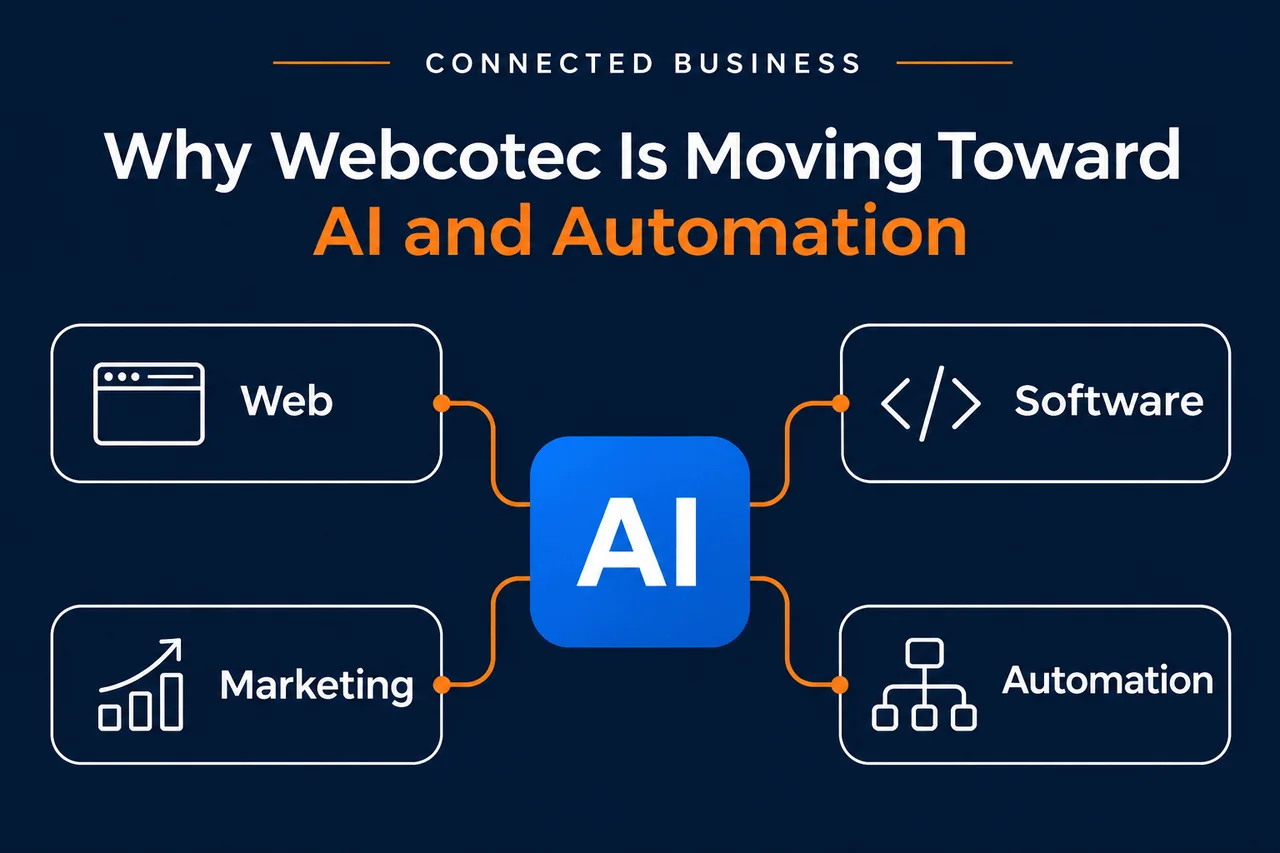
Editorial graphic illustrating the article’s subject.
Why AI is central to Webcotec’s next chapter
Webcotec is moving toward an AI-first approach because a business website is increasingly one part of a larger working system. An enquiry may need to reach a CRM, a customer may need an answer from approved information, and an order may require a sequence of operational updates. Building the visible interface is only part of making those journeys useful.
Our direction is to connect AI capabilities with websites, software and business workflows. This article explains the approach we want clients to understand before starting a project. It does not claim that every internal activity is already automated, or that a particular client has achieved a result we have not documented.
Websites and software remain the foundation
A language model cannot repair an unclear offer, an unreliable checkout or a disconnected database by itself. Customers still need a responsive website, useful product information and a clear way to contact the business. Teams still need maintainable code, appropriate access and integrations they can understand.
That is why Webcotec’s AI direction includes WordPress, Shopify, custom software, APIs, SEO and digital marketing. These technologies provide the interfaces and information an AI-assisted workflow depends on. We select the approach around the task, rather than assume that every website needs a chatbot or every process needs a generative model.
Where we see practical opportunities
Knowledge assistants can help a team find information in approved material and show when an answer needs human help. Document processing can extract proposed fields from invoices or forms before a person checks them. Workflow automation can connect an enquiry, a summary, an assigned owner and the next action. These are service directions and example use cases, not descriptions of named client deployments.
For a Shopify store, a useful starting point could be helping customers find an existing shipping policy, or preparing a support summary for review. Stock updates and order processing may be better served by standard platform features and deterministic integrations. The important question is whether a new component improves the complete customer journey.
How an idea becomes a scoped AI project
We start by understanding the current process: who uses it, where information comes from, which systems it touches and what can go wrong. A proposal should identify the first workflow, the information it may access, the expected output and the point at which a person approves an action. It should also separate setup work from subscriptions and ongoing operating costs.
A pilot needs representative examples and a baseline. We review useful answers as well as missing information, incorrect classifications, slow responses and failed integrations. A working demonstration is not proof that a system is ready for every real request. Launch decisions should follow testing, agreed acceptance criteria and a workable fallback.
People, ownership and review are part of the design
Moving toward AI should help people use their knowledge, rather than make responsibilities unclear. Someone must own the information, review exceptions and decide what the system is permitted to do. Customer-facing promises, changes to important records and sensitive decisions need review appropriate to their consequences.
We also consider what data a provider receives, how access is controlled, how errors are recorded and how the workflow can be changed or switched off. NIST’s generative AI profile is a useful external reference for risk-management discussions. Using it as a reference does not mean Webcotec or a client system has received a NIST certification.
What this means for businesses in Lucknow and India
Our Lucknow team’s direction is practical: understand the business, scope one useful outcome and connect the technology needed to support it. A local service company may prioritise enquiry handling. A retailer may need clearer store operations. A growing software team may need a searchable knowledge workflow. The right starting point depends on the existing systems and the people who will maintain them.
If you are considering AI automation, share the current workflow and the result you want with Webcotec. We can discuss the information, integrations, review steps and project boundaries before recommending a build. Our move toward AI is about making those connected systems more useful, while continuing to deliver the web, software and marketing work businesses rely on.
Common questions
Is Webcotec stopping website and Shopify development?
No. Website development, Shopify, software, SEO and digital marketing remain part of our services. AI and automation connect with those foundations where there is a useful, testable requirement.
Does every Webcotec project include AI?
No. We assess the task and constraints first. Conventional software or rule-based automation may be simpler and more dependable for a particular requirement.
How can a business start an AI project with Webcotec?
Share one repeated process, the systems involved and a description of a successful outcome. We can discuss a bounded pilot, required information, human review and ongoing costs before agreeing a scope.